How to Host a Murder Mystery Party for Kids (Without the Scary Bits)

Kids love a mystery. Give them a magnifying glass, a notebook and a puzzle to solve, and a room of eight-year-olds turns into the most focused detective squad you've ever seen. A mystery party is perfect for birthdays, sleepovers and Christmas holidays, and it's easier to run than most kids' parties because the game gives the afternoon its shape.
The one thing to get right is the "murder" part. For younger kids, there doesn't need to be one. Here's how to host a kid-friendly mystery party, step by step.
Murder mystery for kids: what's different?
A grown-up murder mystery has a body, secrets, betrayals and often some quite dark motives. A kids' version keeps the fun parts (characters, clues, questioning, a big reveal) and swaps the rest:
- Something is stolen or missing, not someone murdered: a crown, a cake, a famous painting, Santa's sleigh bells.
- Motives are silly or sweet: jealousy over a baking prize, wanting to keep a pet secret, a prank gone wrong.
- The culprit isn't evil, just a bit naughty, and usually says sorry at the end.
- Clues are visual and hands-on: footprints, torn notes, a muddy glove, a coded message.
- It's shorter: 60 to 90 minutes instead of two to three hours.
For teenagers (13+), a classic "who killed..." mystery is usually fine, as long as it's free of gore and bad language. For 8 to 12, a missing-object mystery is the safe and genuinely fun choice.
What age is a mystery party good for?
- Ages 6 to 7: a simple treasure hunt with a "who took it?" ending works best. Lots of adult help.
- Ages 8 to 12: the sweet spot for a character-based mystery. Kids can read their character cards, ask questions and follow clues.
- Ages 13+: a full murder mystery party, the same as adults play, but with a teen-friendly kit.
Step 1: Pick a theme kids will love
- A North Pole mystery at Christmas: who stole Santa's sleigh bells?
- The missing birthday cake: perfect for a birthday, and the cake turns up at the end.
- Museum heist: the famous diamond has vanished from the museum.
- Magic school: someone has stolen the head teacher's wand.
- Pirate ship: the captain's treasure map is gone.
- Circus or funfair: the ringmaster's top hat (and the rabbit in it) has disappeared.
Step 2: Plan the number of players
Most kids' mystery games work best with 8 to 12 players, each playing one character. If you have fewer, adults can play the extra characters. If you have more:
- pair kids up so two share one character;
- make extra kids "detective assistants" who carry the evidence and ask questions;
- or split into two teams racing to solve the same mystery.
Step 3: Send characters with the invitations
Kids are far more excited if they know their character in advance. Send each child:
- their character's name and a sentence about them ("Twinkle, the elf who's always late");
- a costume idea (simple: a hat, a scarf, an apron, elf ears);
- one fun secret to keep.
Tell parents roughly how long the game runs and that it's not scary. That reassures everyone.
A video invitation is quick to make and kids love seeing it: the Template Studio has animated birthday invitations for kids, with a matching printable card.
Step 4: Set the scene
- The crime scene: a table or corner with "police tape" (yellow paper or masking tape) and the empty spot where the stolen item was.
- Evidence table: lay out clues as they're revealed.
- Detective kit for each child: a notebook, pencil, name badge and a paper magnifying glass. Kids treasure these.
- Music: something playful and a bit mysterious.
Step 5: Run the game in three short rounds
- The discovery (5 minutes). Read out what happened. Show the empty spot where the item used to be.
- Round one (15 minutes). Each child introduces their character and says where they were. Reveal the first two clues.
- Snack break (10 minutes).
- Round two (15 minutes). New clues. Kids question each other. Someone will be loudly accused; that's half the fun.
- Round three (15 minutes). The final clues and a twist.
- Accusations (5 minutes). Every child writes down who they think did it and why.
- The reveal (5 minutes). Read the solution. The culprit confesses (in character) and returns the stolen item.
- Awards. Best detective, best costume, best actor, best accuser. Make sure every child wins something.
The whole game takes 60 to 90 minutes, which fits nicely into a two-hour party with food and cake.
Tips for keeping it fun (and calm)
- Keep an adult in charge of reading clues and keeping order. Kids get excited, and someone will try to read the solution.
- Help struggling readers quietly. Pair them with a confident reader, or read their lines with them.
- Don't let anyone be the "bad guy" for long. The culprit should feel like the star of the reveal, not the villain.
- Choose a culprit who'll enjoy it. If the game lets you pick, give the role to a child who'll love the attention.
- Have a sensory break. A snack table or a colouring corner gives overwhelmed kids somewhere to reset.
- Give everyone a prize. Certificates and small treats for every detective.
Food for a kids' mystery party
- "Evidence bags": sandwich bags of popcorn or sweets labelled "EXHIBIT A".
- Fingerprint cookies: thumbprint biscuits with jam.
- Magnifying glass lollipops.
- A "crime scene" cake with the stolen item on top, revealed at the end.
- Mocktails with silly names: "The Getaway Punch", "Detective Fizz".
A Christmas mystery for kids
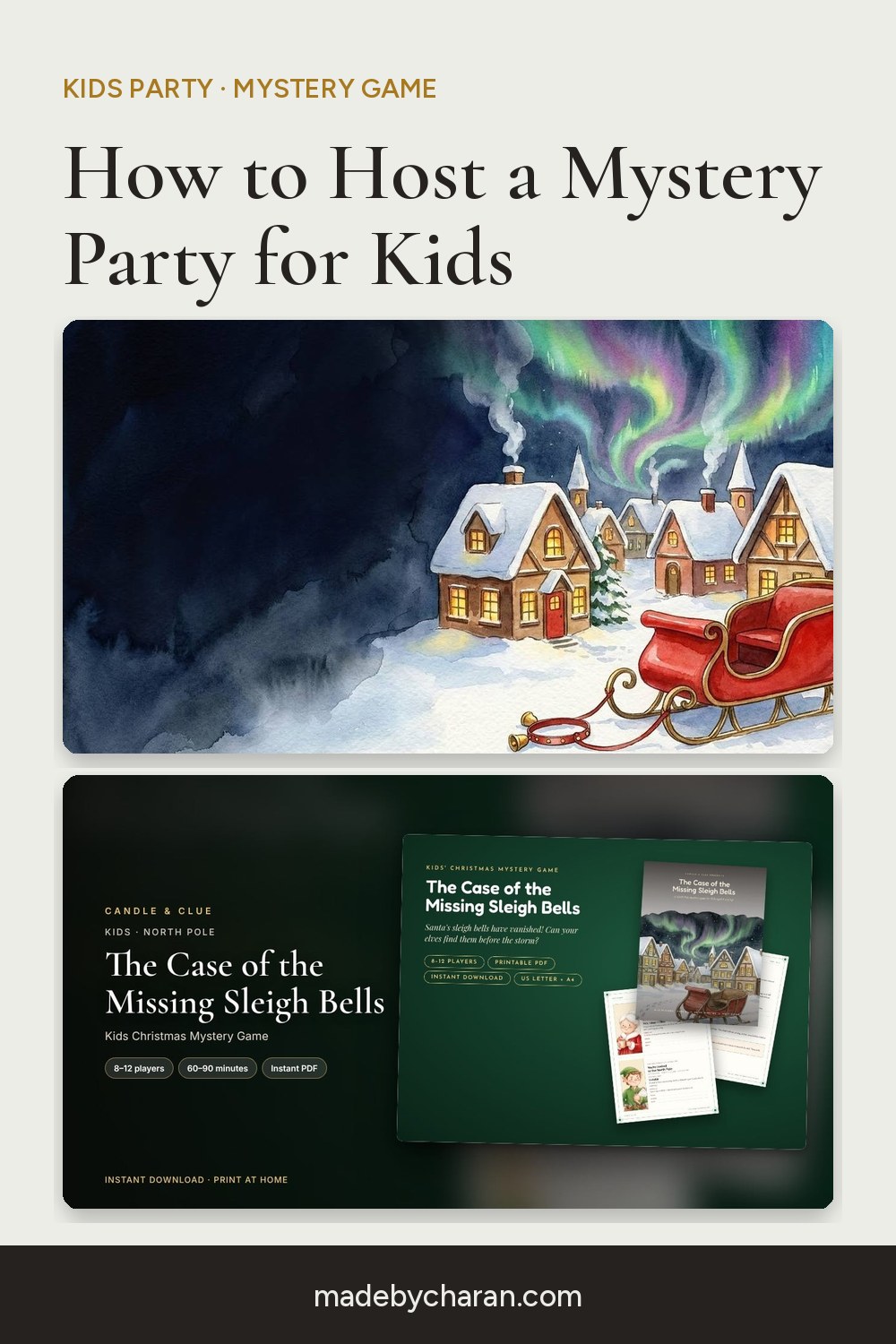
For a ready-made option, The Case of the Missing Sleigh Bells is a printable Christmas mystery for kids aged 8+ and 8 to 12 players. It's Christmas Eve at the North Pole, a storm is coming, and Santa's twelve golden sleigh bells have vanished. Without them, the sleigh can't fly, and the elves have until six o'clock to find out who took them.
There's no murder and nobody gets hurt. You get 12 characters (8 core plus 4 optional, so it works whether 8 or 12 kids turn up), each with their own booklet, plus invitations, name tags, evidence props revealed round by round, a detective notebook, accusation slips, award certificates and a host guide with everything to read out. It plays in about 60 to 90 minutes and the solution is sealed until the end.
For quieter moments, the Christmas Activity Pack for Kids has puzzles, mazes, a secret code page, colouring and Christmas bingo for ages 4 to 10, which works well as a calm-down table after the reveal.
Want to try a mystery first? Play one of our free Candle & Clue mysteries with an older child on a phone or tablet. One of the free cases is the same North Pole sleigh bells story.
Hosting for teenagers instead? A teen group can play a full adult kit. See how to host a Christmas murder mystery party for the grown-up version.
FAQ
Is a murder mystery party appropriate for kids?
Yes, if you choose a kids' version where something is stolen or missing rather than someone being killed. Teens 13+ can usually play a gore-free adult mystery.
What age is a kids' mystery party for?
Ages 8 to 12 is the sweet spot for character-based mysteries. Younger children enjoy simpler treasure-hunt mysteries with adult help.
How long does a kids' mystery game take?
About 60 to 90 minutes, in three short rounds. Plan a two-hour party with food, cake and the game.
How many kids do you need?
Eight to twelve is ideal. With fewer, adults can play the extra characters; with more, pair kids up or add detective assistants.
Can I use a mystery game for a birthday party?
Absolutely. Make the birthday child the lead detective, or give them the culprit role if they'd love the big reveal.
What do kids need for a mystery party?
A character for each child, printed clues, a notebook and pencil each, name badges, a simple costume idea and an adult to run the game.
A kids' mystery party is noisy, silly and surprisingly focused. And there's nothing quite like a room of young detectives gasping when the culprit is finally unmasked.