How to Teach Your Child Telugu, Hindi or Tamil at Home
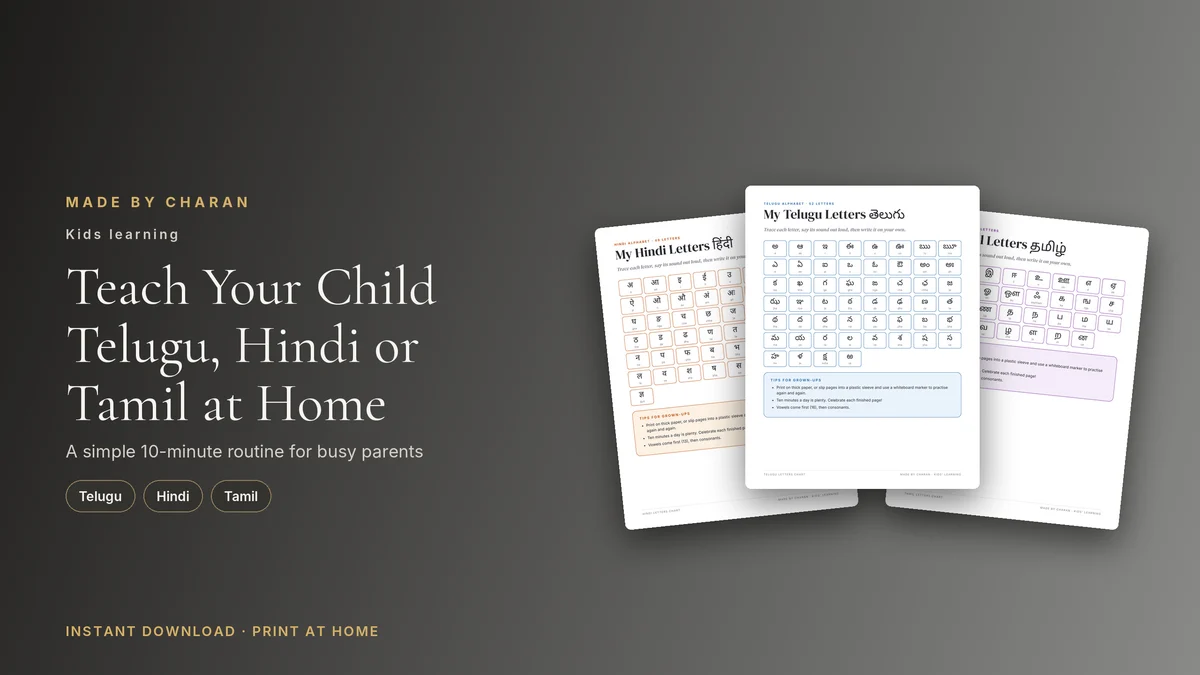
If your family speaks Telugu, Hindi or Tamil at home but your children are growing up surrounded by English, you've probably felt this: they understand Amma and Nanna perfectly, but answer in English. Or they can chat with their grandparents but can't read a single letter.
That's completely normal, and it's not too late. Children pick up a second script surprisingly fast when it's short, regular and fun. Here's a simple, realistic plan for busy parents, whether you live in the US, the UK, Canada, Australia or anywhere else.
Start with speaking, then letters
Reading and writing stick much better when the child already knows the words. Before you open a workbook, make the language part of everyday life:
- Pick one routine that's always in the family language. Breakfast, bath time or the drive to school. Consistency beats quantity.
- Name things around the house. Fruits, body parts, colours, animals. Point and say, then ask them to point.
- Use grandparents. A weekly video call where the child has to ask one question in the language is worth more than an hour of flashcards.
- Songs and rhymes. Short rhymes are the fastest way to get the sounds right.
Once your child can say a handful of words, introducing the letters makes sense: the letters now stand for sounds they already know.
How to teach the letters: little and often
Ten minutes a day, four or five days a week, works far better than one long session on the weekend. A simple routine:
- Say the sound together. Point to the letter, say its sound, and have your child repeat it.
- Trace it. Big trace-me letters with a finger first, then with a pencil.
- Write it alone. One or two tries without the guide.
- Find it. Look for the letter on a food packet, a wedding card or a festival greeting.
- Stop while it's still fun. End on a letter they got right.
Do two or three new letters a week and review the old ones every session. Over a few months, that covers the whole alphabet.
Telugu: achulu and hallulu
Telugu has 52 letters in the commonly taught set: the vowels (achulu) and the consonants (hallulu). Start with the vowels, since they appear everywhere and many are easy to say. Then move through the consonants in the traditional order, which groups similar sounds together.
The Telugu Alphabet Tracing Book covers all 52 letters, each with its romanised sound and trace-and-write practice, plus a letter chart for the fridge and a certificate for the end.
Hindi: swar and vyanjan
Hindi uses the Devanagari script, with vowels (swar) and consonants (vyanjan). The horizontal top line (shirorekha) is a nice early win: kids love "hanging" letters from it. Teach the vowels first, then the consonant groups.
The Hindi Alphabet Tracing Book has 49 letters, swar and vyanjan, with sounds, tracing practice, a chart and a certificate.
Tamil: uyir and mei
Tamil has vowels (uyir ezhuthukal) and consonants (mei ezhuthukal), which later combine into many more letters. Learning the 12 uyir and 18 mei letters first gives children the building blocks for everything else.
The Tamil Alphabet Tracing Book covers the uyir and mei letters with sounds, tracing pages, a chart and a certificate.
Teaching more than one language?
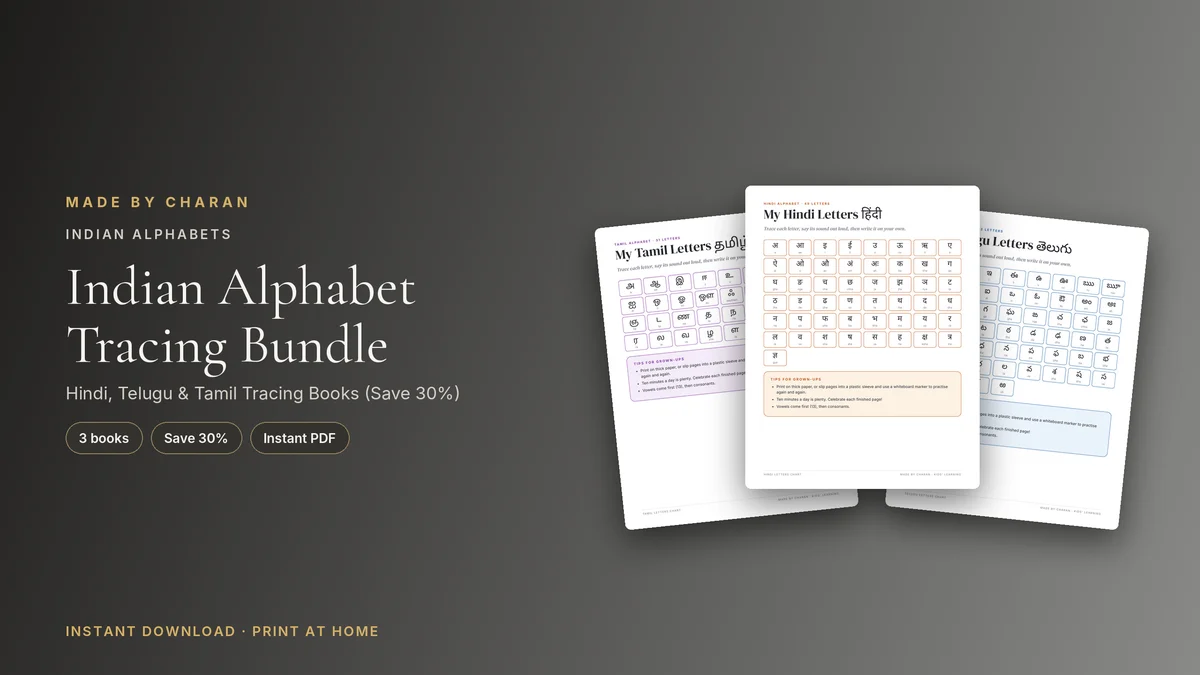
Many families speak one language at home and another with grandparents, or want cousins to learn together. The Indian Alphabet Tracing Bundle has the Hindi, Telugu and Tamil books in one download for 30% less than buying them separately. It's also a thoughtful gift from grandparents.
Keep them motivated
- Celebrate small wins. A sticker for every letter, and a proper celebration when they finish the book.
- Make it useful. Have them write their name, or "Happy Birthday" on a card for a grandparent.
- Festivals are perfect moments. Diwali, Sankranti, Pongal or Ugadi are great times to learn a festival word or write a greeting.
- Don't correct everything. If they're speaking the language at all, that's a win. Gentle repetition works better than correction.
FAQ
What age should my child start learning letters?
Most children are ready to trace letters between ages 3 and 7, once they can hold a pencil comfortably. Speaking can start from birth.
My child only answers in English. Should I insist?
Gently. Keep speaking the language yourself, praise any attempt they make, and create situations (like grandparent calls) where the language is the natural choice.
Can I print the worksheets more than once?
Yes. Print the pages as often as you like for your own family, so siblings can use them too, or you can repeat letters that need extra practice.
Do the books come in A4 and US Letter?
Yes, each book includes both sizes, so it prints correctly wherever you live.